A selection of maps and landscape analyses from the Byzantine Agricultural Landscape Across the Aegean (BALAA) project database set. These images serve as practical and utility tools, visualizing the project’s core data for the two primary study areas: Amorium in Asia Minor and Messene in the Peloponnese.
The catalogue utilizes a combination of modern high-resolution satellite imagery, historical orthophotography (pre-1945), and advanced Geographic Information Systems (GIS) modeling. Methodologies on display include: Historic Landscape Characterization (HLC), Normalized Difference Vegetation Index (NDVI) filtering to identify constructions, Detailed modeling of topography, elevation (masl), and terrain slope, Hydrological analysis of actual and reconstructed stream/river routes, Systematic mapping of agricultural features, such as historical field boundaries, stone field walls, and agricultural terraces.
The primary goal of this analysis is to identify and compare the diachronic development of the agricultural landscapes at both sites. This includes distinguishing modern cultivation patterns from surviving historical (and potentially Byzantine) field systems, such as the “strip-fields” identified at Amorium and the extensive terracing at Messene.
This document contains an indicative selection of these analyses. The full, detailed data is contained within the project’s accessible upon-request GIS files. All material is under copyright of the BALAA Project (@BALAA, @IMS/FORTH, @Nikos Tsivikis).
Catalogue of Maps
Amorium
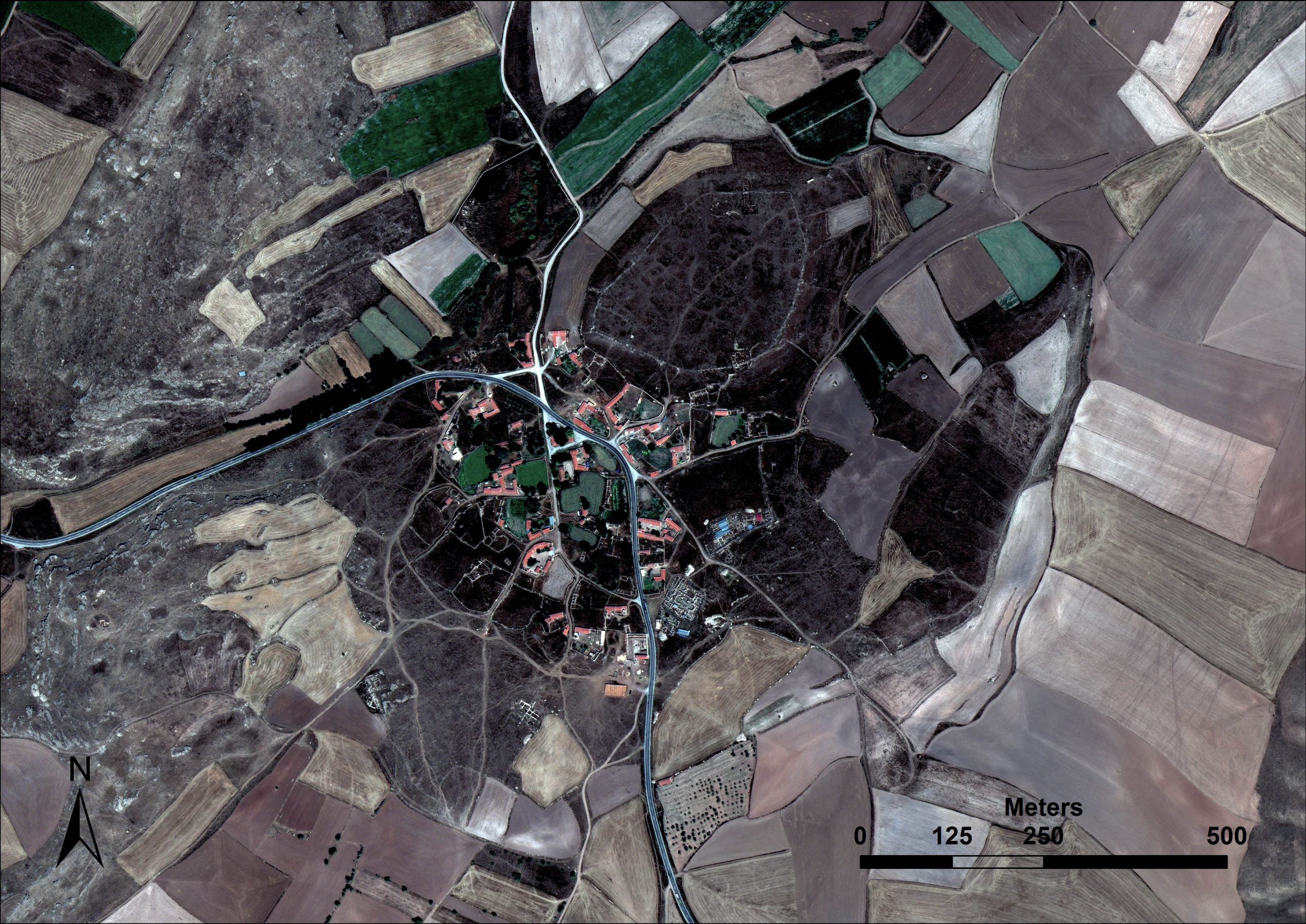
Amorium Study Area - Satellite imagery of site with mapping. Natural
Figure 1: Amorium Study Area - Satellite imagery of site with mapping. Natural. This image provides a high-resolution, natural color satellite view of the immediate Amorium site, set at a 500-meter scale. It clearly shows the core settlement area, characterized by vegetation and visible structures, surrounded by the modern agricultural landscape. This map establishes the immediate spatial context of the archaeological site in relation to the surrounding fields. All material is under copyright of the BALAA Project (@BALAA, @IMS/FORTH, @Nikos Tsivikis).
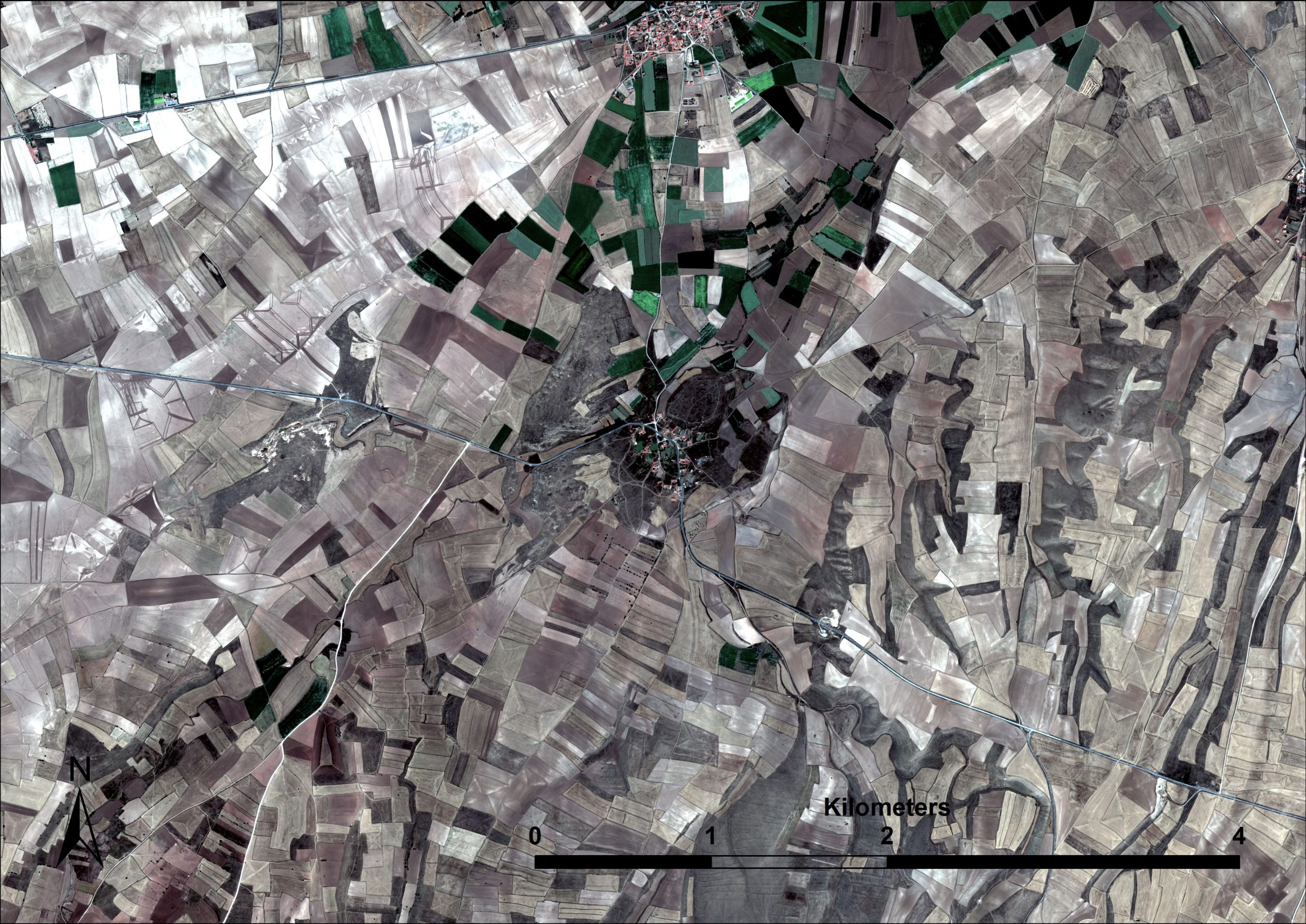
Amorium Study Area - Satellite imagery of general Amroum area (10 km) with mapping. Natural
Figure 2: Amorium Study Area - Satellite imagery of general Amroum area (10 km) with mapping. Natural. Expanding the view from Figure 1, this map shows the general "Amroum" (Amorium) area within a wider 10 km context, at a 4-kilometer scale. This broader perspective illustrates the site's position within the larger regional landscape, showing its relationship to distant field systems, watercourses, and modern infrastructure, providing a macro-regional context for the study. All material is under copyright of the BALAA Project (@BALAA, @IMS/FORTH, @Nikos Tsivikis).
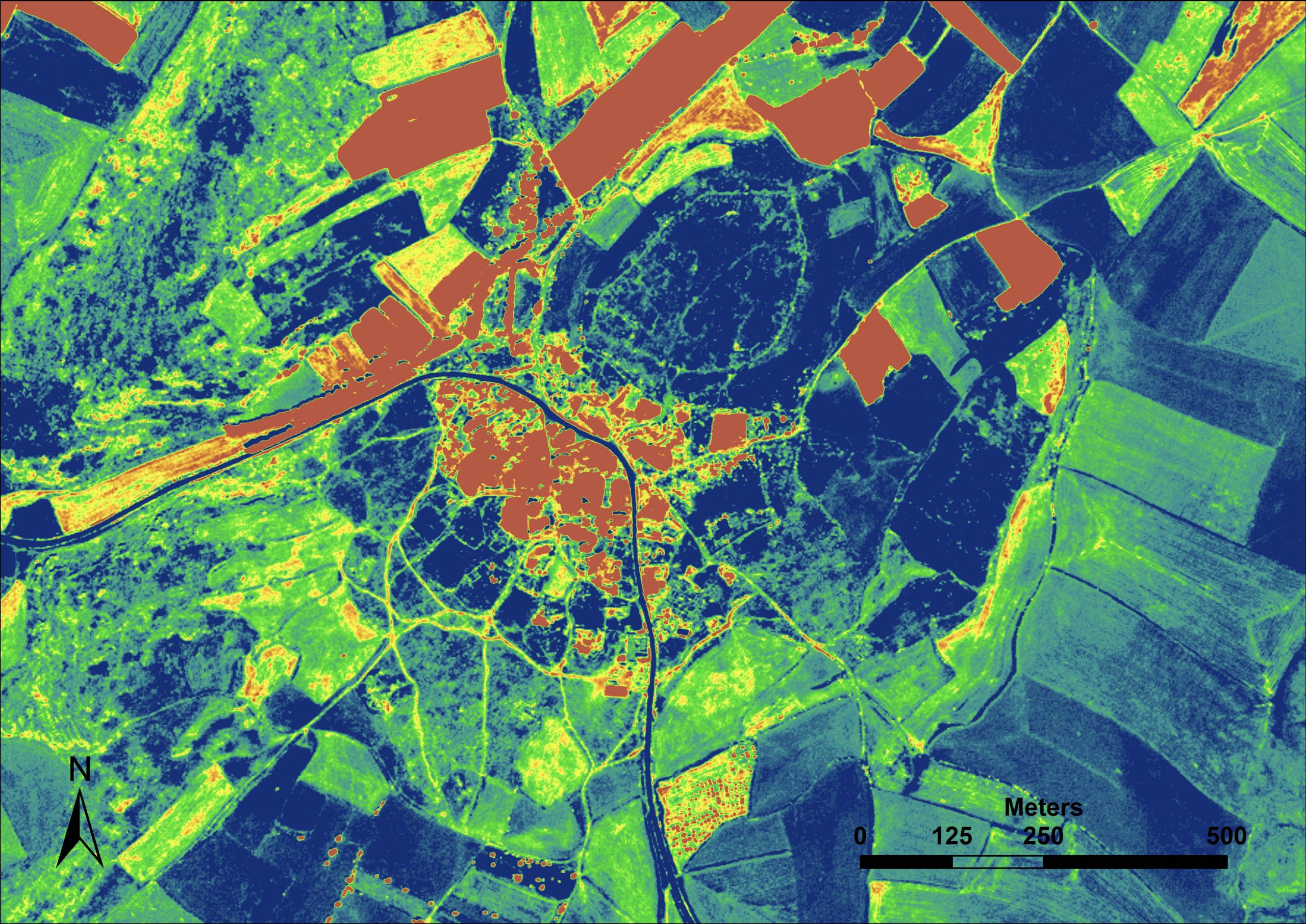
Amorium Study Area - Satellite imagery with constructions (NDVI filter)
Figure 3: Amorium Study Area - Satellite imagery with constructions (NDVI filter)
This is a technical analysis of the same close-up area seen in Figure 1. An NDVI (Normalized Difference Vegetation Index) filter has been applied, which highlights differences between vegetation (green/yellow) and non-vegetated or constructed areas (red/orange). This method is used to precisely map the extent of buildings, walls, and other constructions within the settlement area, distinguishing them from the surrounding vegetation. All material is under copyright of the BALAA Project (@BALAA, @IMS/FORTH, @Nikos Tsivikis).
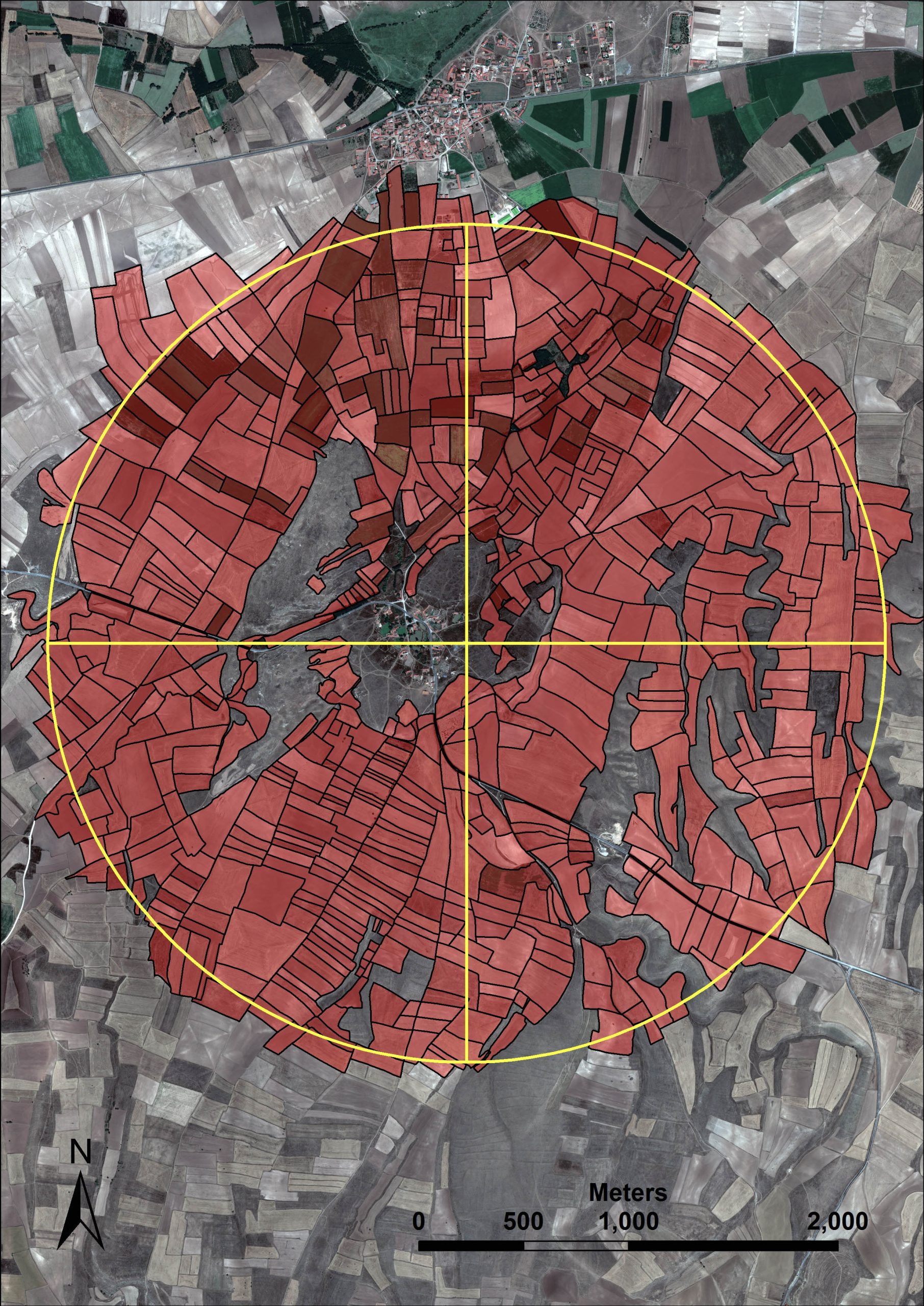
Amorium Study Area - Satellite imagery with HLC in 2 km radius
Figure 4: Amorium Study Area - Satellite imagery with HLC in 2 km radius. This map displays the application of Historic Landscape Characterization (HLC) within a 2-kilometer radius of the central site. The area is quartered, and field parcels are overlaid as red polygons on the satellite base. This analysis helps to categorize and quantify different types of historical land use and field patterns, revealing the structured, and possibly radial, organization of the landscape closest to the settlement. All material is under copyright of the BALAA Project (@BALAA, @IMS/FORTH, @Nikos Tsivikis).
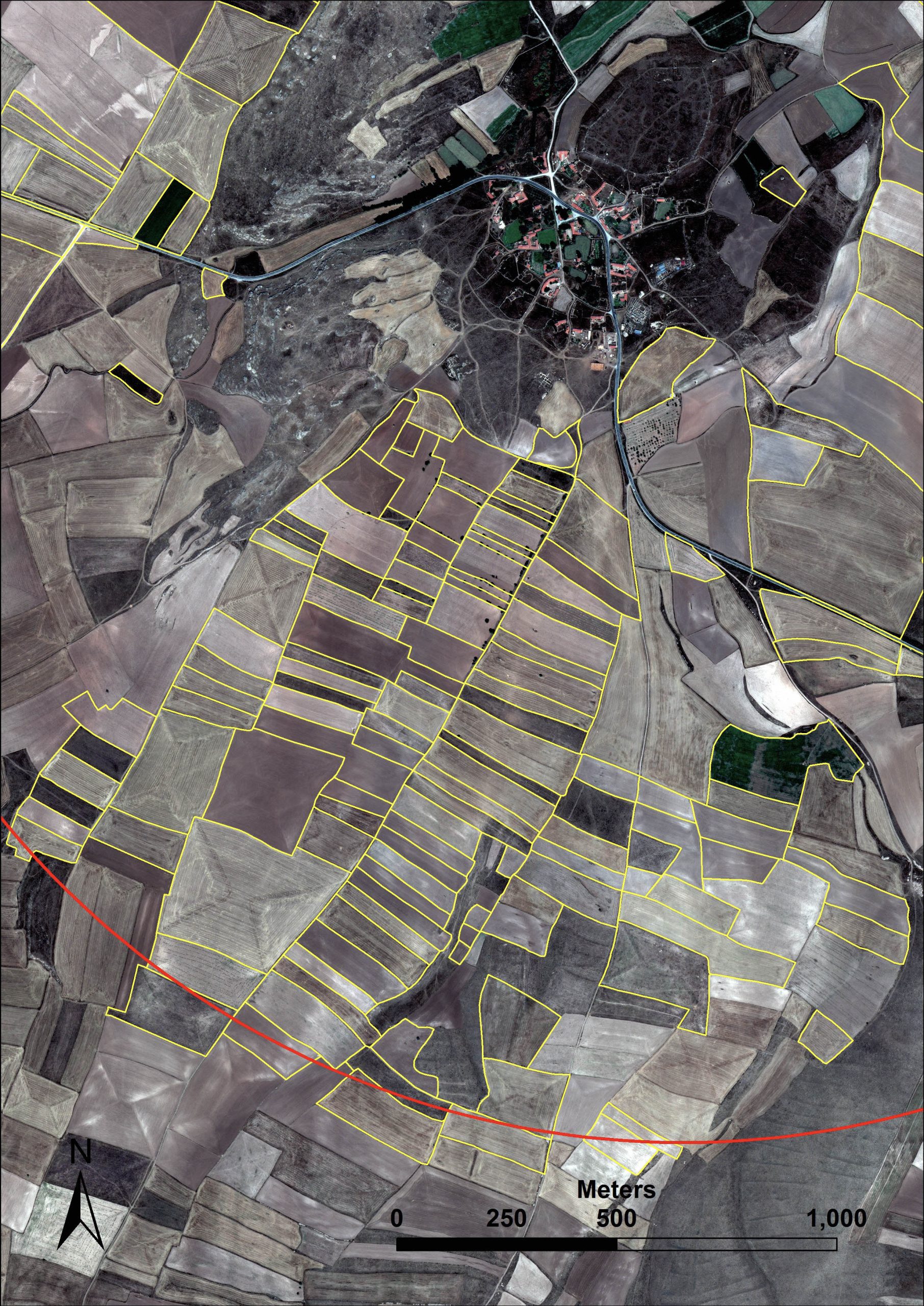
Amorium Study Area - Satellite imagery of SE quadrant of Amorium with evidence of historical (byzantine) field systems
Figure 5: Amorium Study Area - Satellite imagery of SE quadrant of Amorium with evidence of historical (byzantine) field systems. Focusing on the southeastern quadrant of the study area, this image uses yellow outlines to highlight specific field systems visible on the satellite base. It specifically points to the presence of long, narrow, parallel "strip-fields," which are presented as evidence of historical, and potentially Byzantine, cultivation patterns. These stand in contrast to the larger, more irregular modern plots. All material is under copyright of the BALAA Project (@BALAA, @IMS/FORTH, @Nikos Tsivikis).
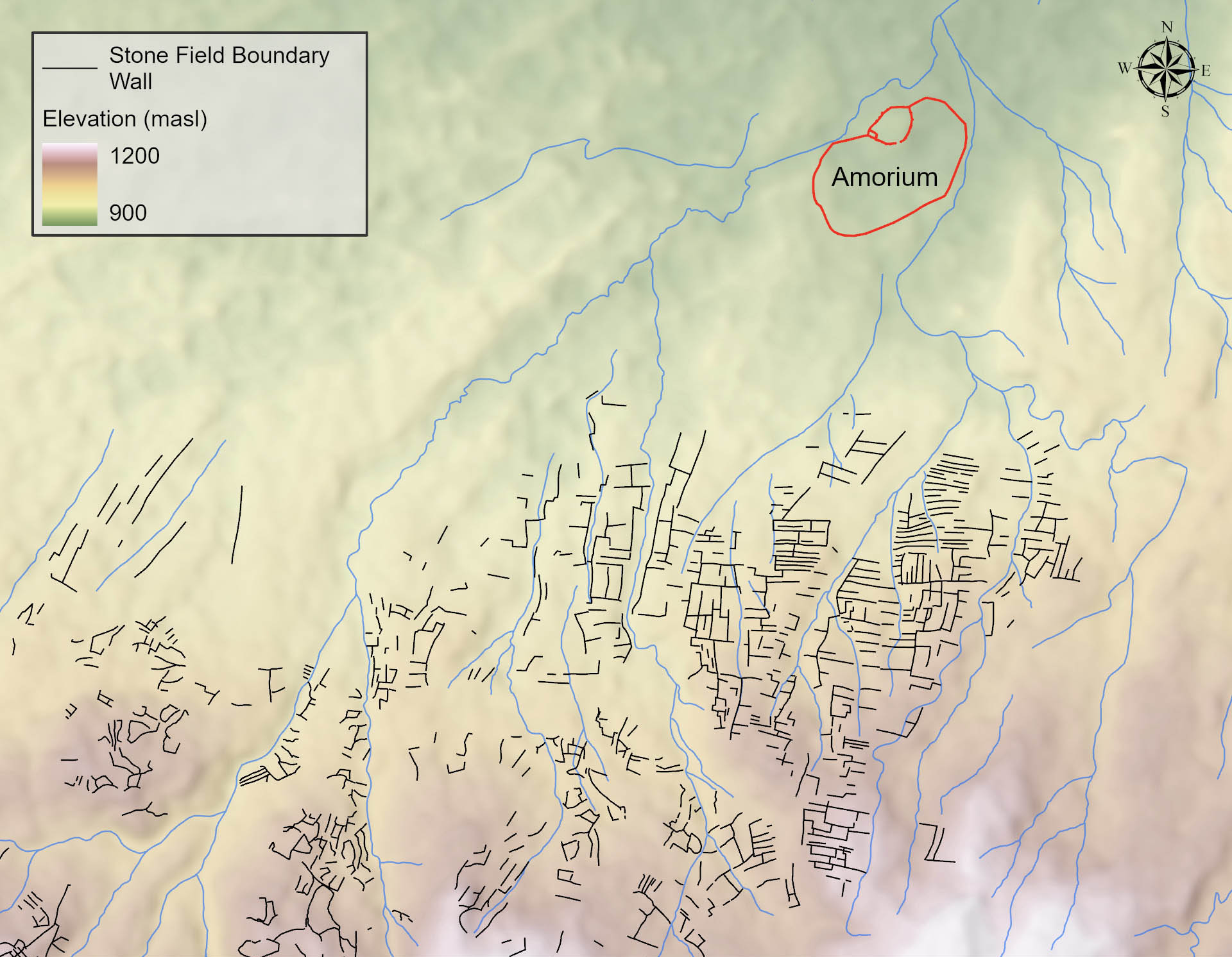
Amorium Study Area - GIS modelling of stone field boundary walls in Agricultural Landscape south of Amorium with elevation (masl)
Figure 6: Amorium Study Area - GIS modelling of stone field boundary walls... with elevation (masl). This is a GIS-generated map, not a satellite photo. It models the extensive network of stone field boundary walls (black lines) located in the agricultural landscape south of Amorium. This network is overlaid on a digital elevation model (DEM) showing altitude in meters above sea level (masl), ranging from 900 to 1200 meters. All material is under copyright of the BALAA Project (@BALAA, @IMS/FORTH, @Nikos Tsivikis).
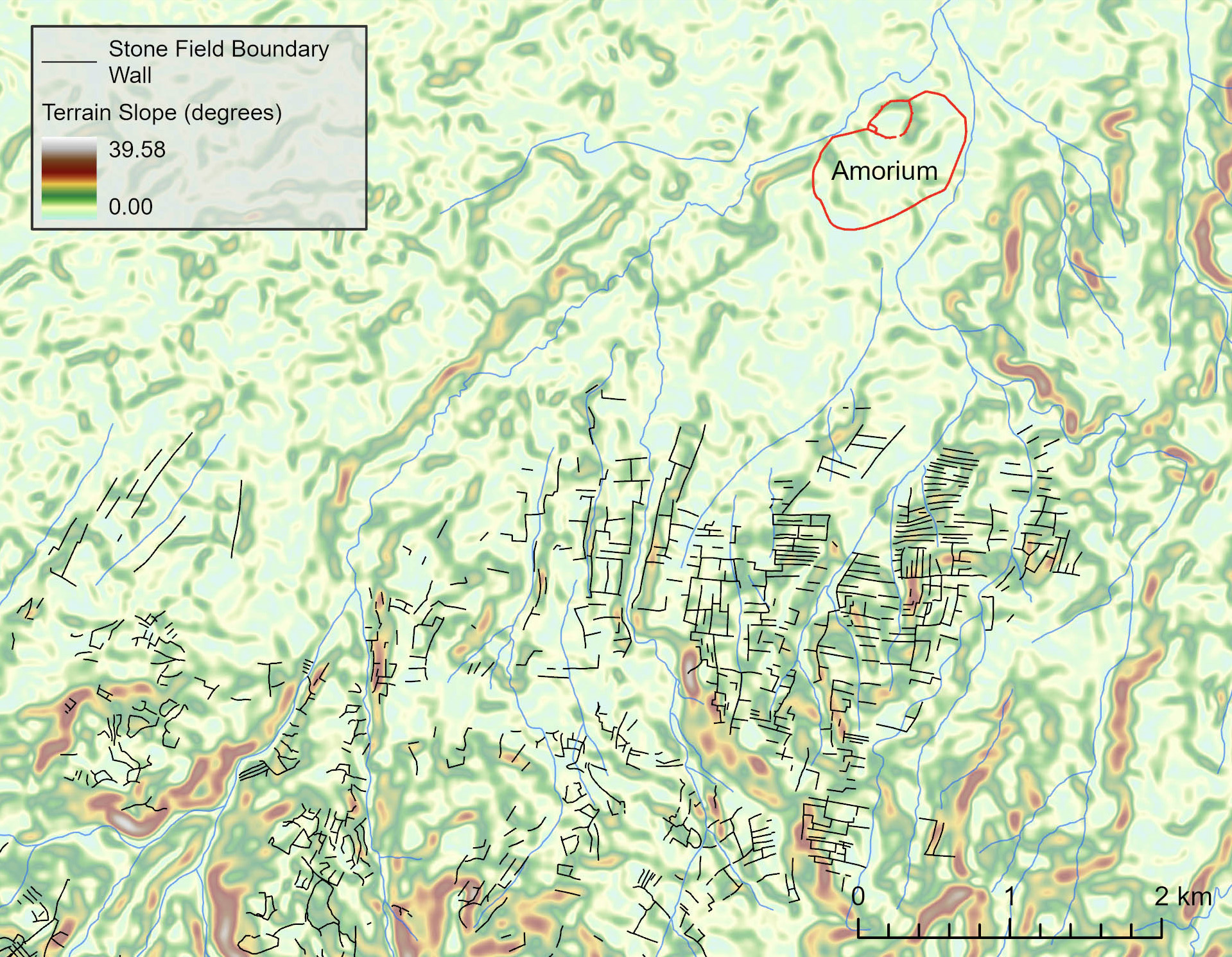
Amorium Study Area - GIS modelling of stone field boundary walls in Agricultural Landscape south of Amorium with Terrain Slope (degrees)
Figure 7: Amorium Study Area - GIS modelling of stone field boundary walls... with Terrain Slope (degrees). This map uses the same base data of stone field boundary walls (black lines) as Figure 6. However, it replaces the elevation layer with a terrain slope analysis, measured in degrees. The color gradient from green (0.00 degrees) to red (39.58 degrees) illustrates how these field systems and boundary walls are situated in relation to the steepness of the terrain, often following contours. All material is under copyright of the BALAA Project (@BALAA, @IMS/FORTH, @Nikos Tsivikis).
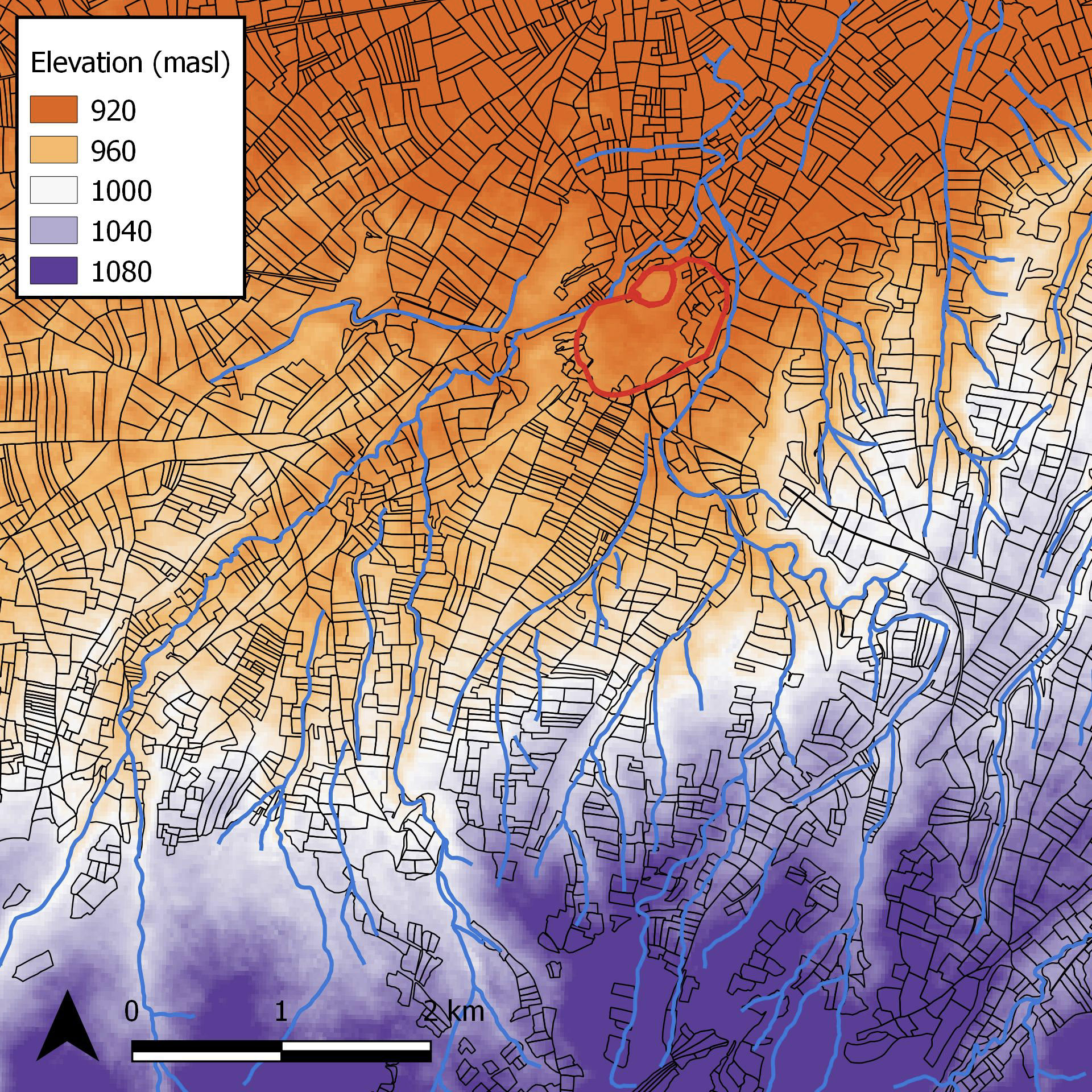
Amorium Study Area - GIS modelling of agricultural landscape south of Amorium with elevation analysis and stream:river routes
Figure 8: Amorium Study Area - GIS modelling of agricultural landscape south of Amorium with elevation analysis and stream/river routes. This GIS model combines three data types: the network of historical field boundaries (black lines), elevation analysis (color-coded from 920 to 1080 masl), and the hydrological network of stream and river routes (blue lines). This composite view allows for a sophisticated analysis of how the agricultural landscape was organized in relation to both topography and water resources. All material is under copyright of the BALAA Project (@BALAA, @IMS/FORTH, @Nikos Tsivikis).
Amorium Study Area - GIS modelling of historical field boundaries (below current state)
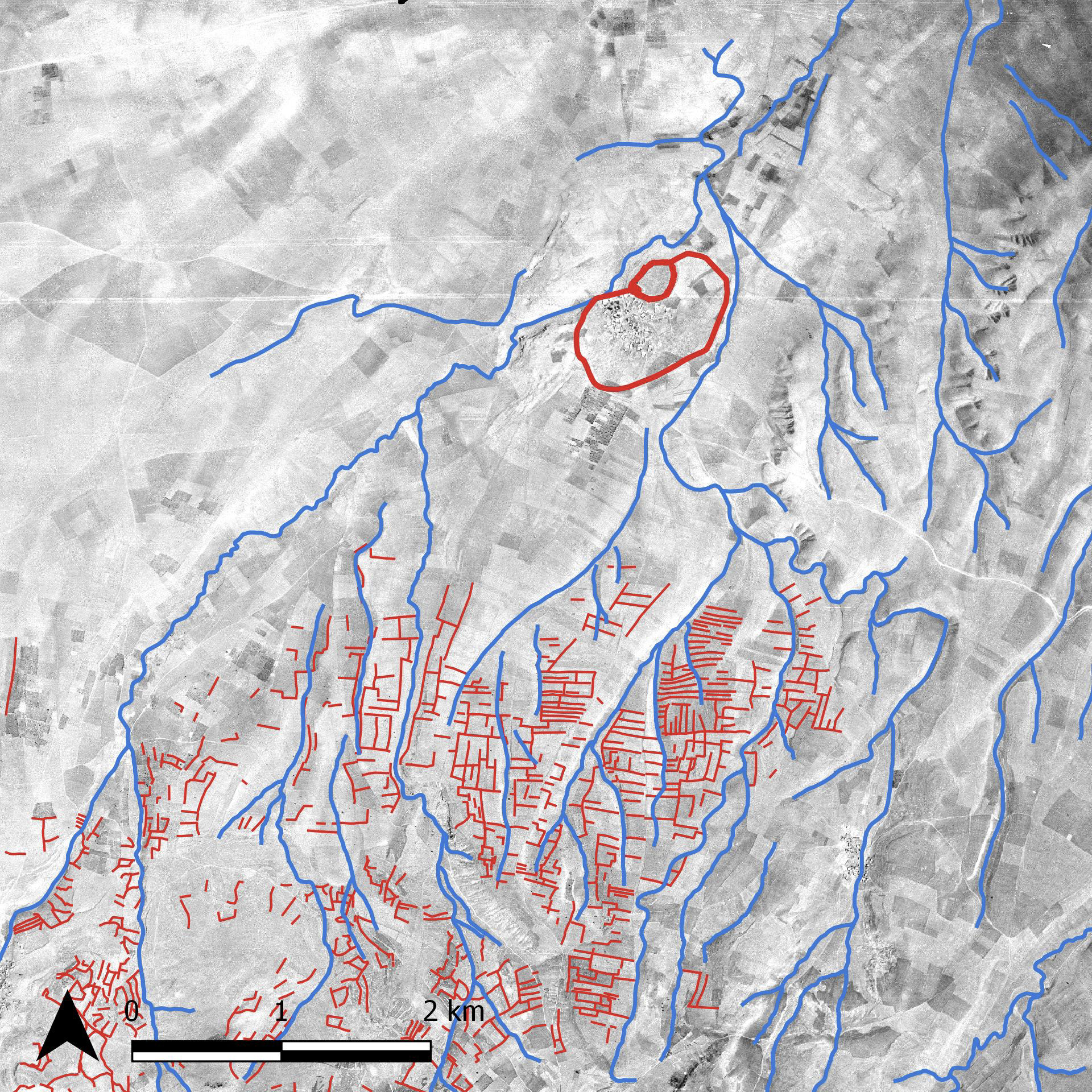
Figure 9: Amorium Study Area - GIS modelling of historical field boundaries (below current state). This map overlays modeled historical data onto a greyscale aerial or satellite base. It visualizes the historical field boundaries (red lines) and the hydrological network (blue lines) as they exist "below" the current, modern landscape. This retrospective analysis helps reveal the persistent, underlying structure of the historical landscape that has since been partially obscured. All material is under copyright of the BALAA Project (@BALAA, @IMS/FORTH, @Nikos Tsivikis).
Amorium Study Area - GIS modelling of agricultural features in S quadrant of Amorium with streams (actual)
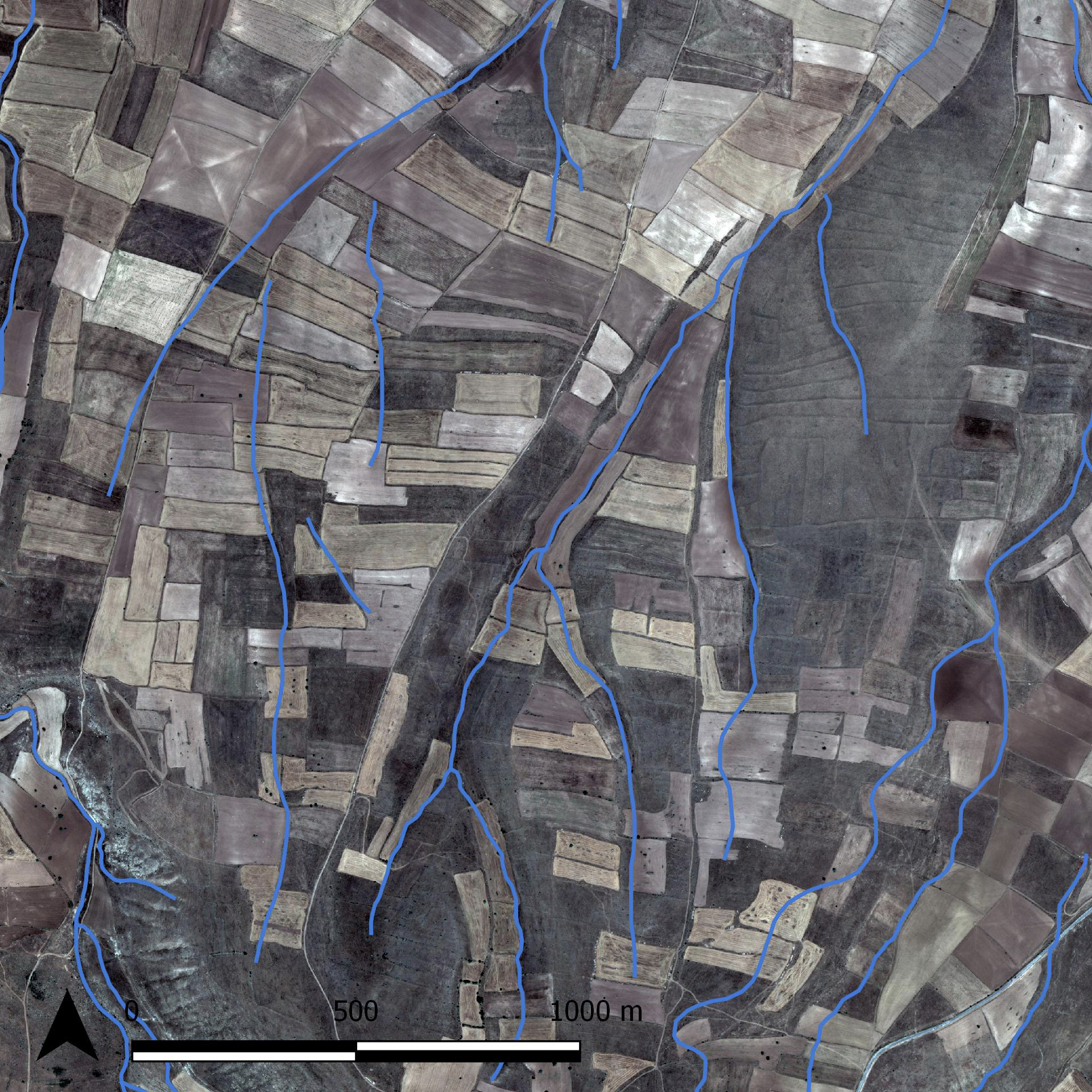
Figure 10: Amorium Study Area - GIS modelling of agricultural features in S quadrant of Amorium with streams (actual). This map focuses on the southern quadrant of Amorium, displaying the actual or current network of streams (blue lines) as they flow through the modern agricultural fields visible on the satellite image. This serves as a baseline for comparison with the reconstructed data, showing the present-day hydrological situation. All material is under copyright of the BALAA Project (@BALAA, @IMS/FORTH, @Nikos Tsivikis).
Amorium Study Area - GIS modelling of agricultural features in S quadrant of Amorium with streams (reconstructed)
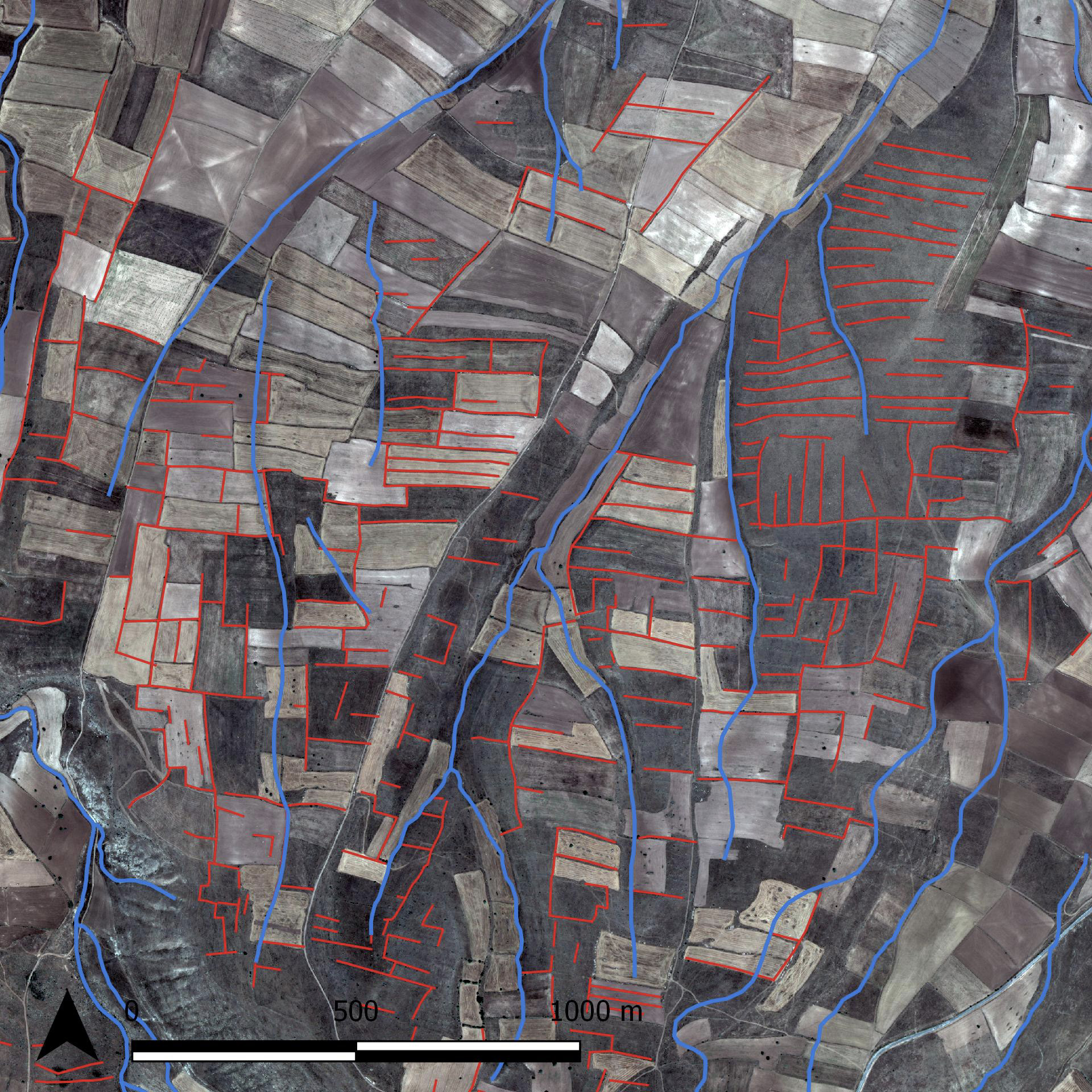
Figure 11: Amorium Study Area - GIS modelling of agricultural features in S quadrant of Amorium with streams (reconstructed). A companion to the previous figure, this map shows the same southern quadrant. However, it models reconstructed streams (blue lines) alongside reconstructed agricultural features (red lines). This comparison highlights how watercourses and field systems may have been altered over time, either through natural processes or human intervention, such as drainage or irrigation. All material is under copyright of the BALAA Project (@BALAA, @IMS/FORTH, @Nikos Tsivikis).
Amorium Study Area - Agricultural fields : polygons S of Amorium
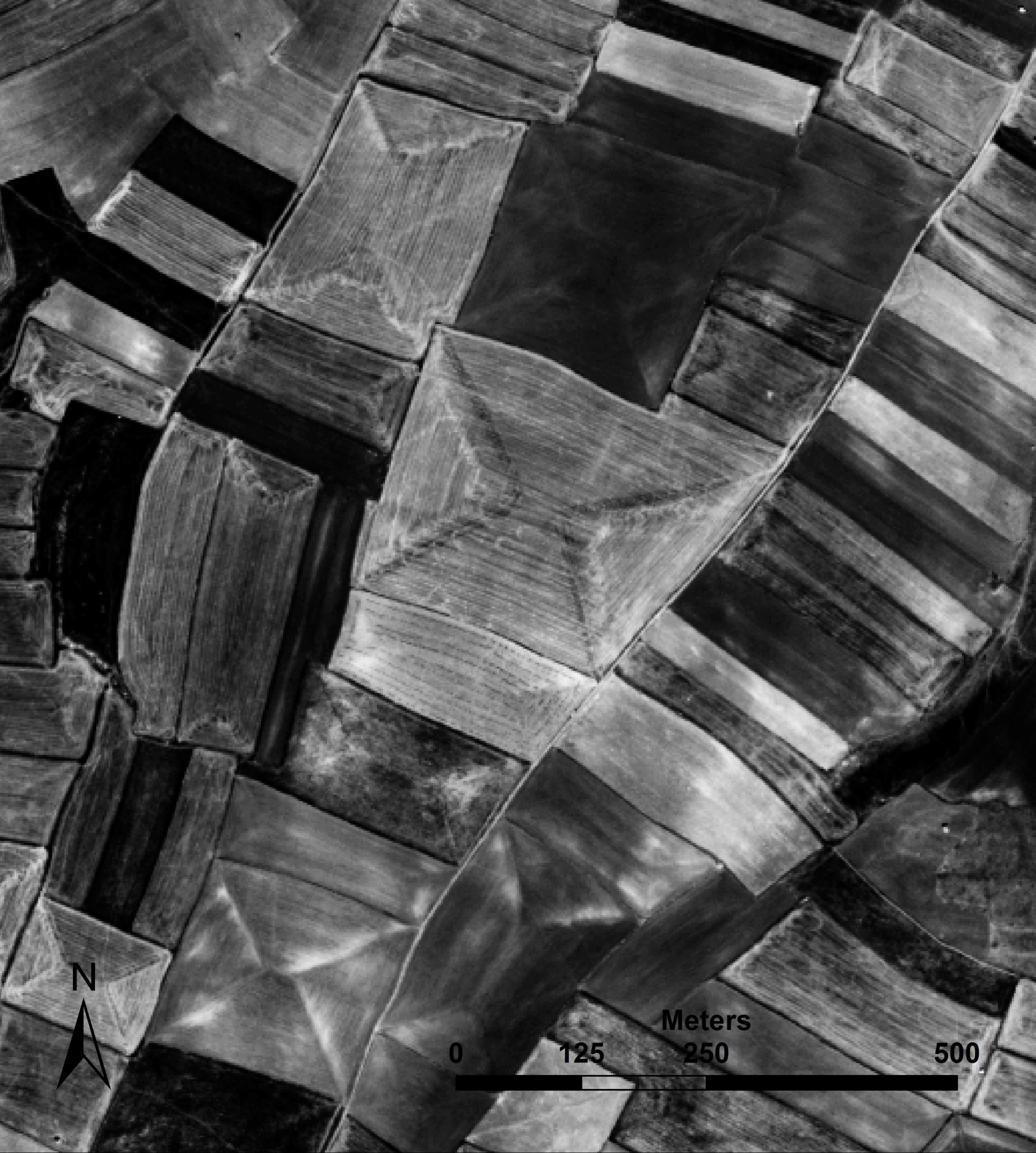
Figure 12: Amorium Study Area - Agricultural fields / polygons S of Amorium. This striking black-and-white aerial image clearly juxtaposes two different cultivation systems south of Amorium. As the caption notes, the left side shows modern, orthogonal (grid-like) fields, while the right side shows "skewed strip-fields". This direct visual comparison strongly suggests the "strip-fields" belong to an older, historical (possibly Byzantine) land-use pattern that pre-dates the modern system. All material is under copyright of the BALAA Project (@BALAA, @IMS/FORTH, @Nikos Tsivikis).
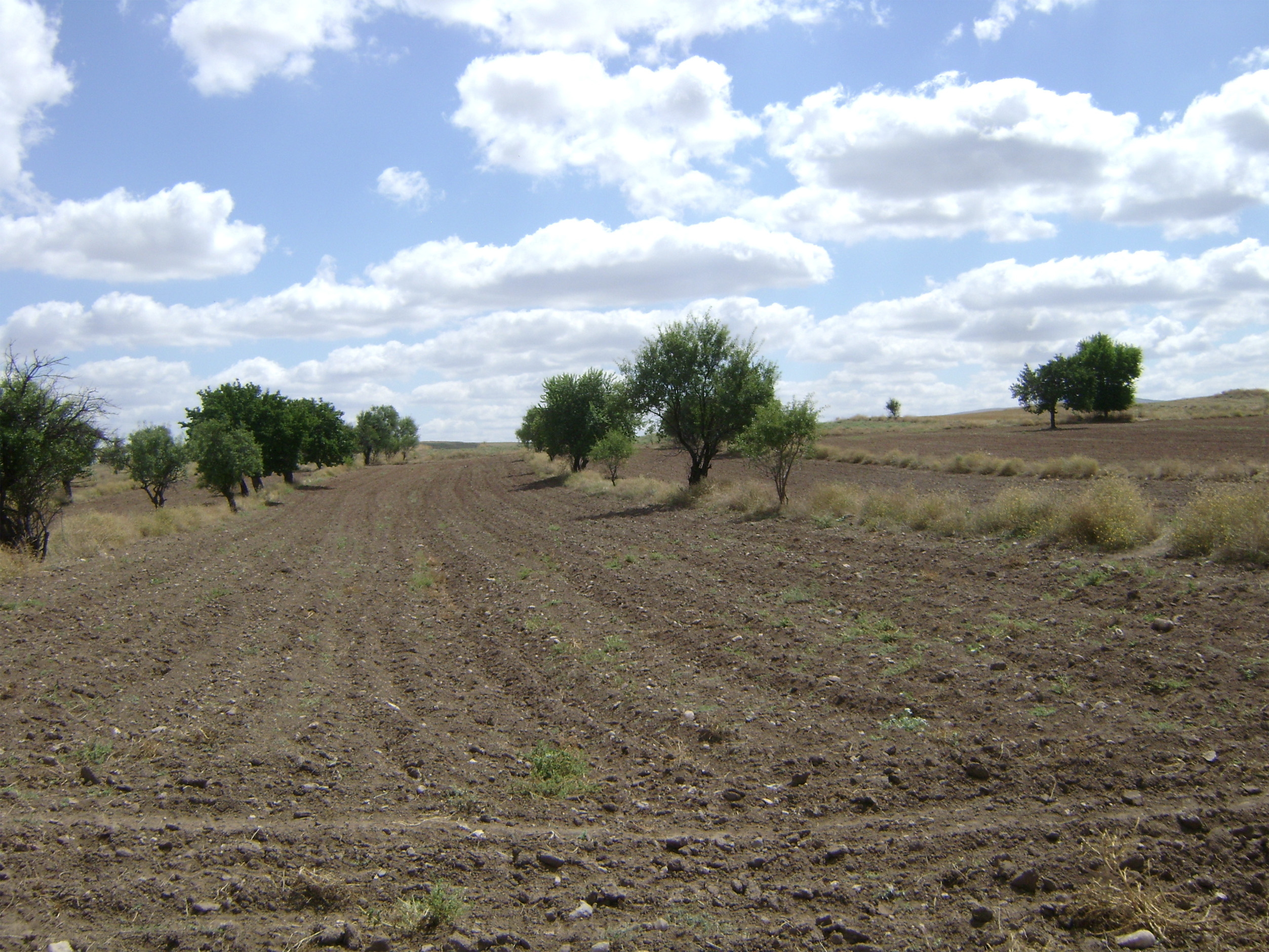
Amorium Study Area - Typical medieval (byzantine?) strip field system cultivation in SE quadrant of Amorium
Figure 13: Amorium Study Area - Typical medieval (byzantine?) strip field system cultivation in SE quadrant of Amorium. This is a ground-level photograph, providing a terrestrial perspective of the features mapped from the air. It shows a freshly plowed field that exemplifies the long, narrow, "strip" characteristic of the medieval (Byzantine?) cultivation system identified in the southeastern quadrant. The trees lining the boundary help to delineate the shape and scale of the parcel. All material is under copyright of the BALAA Project (@BALAA, @IMS/FORTH, @Nikos Tsivikis).
Messene
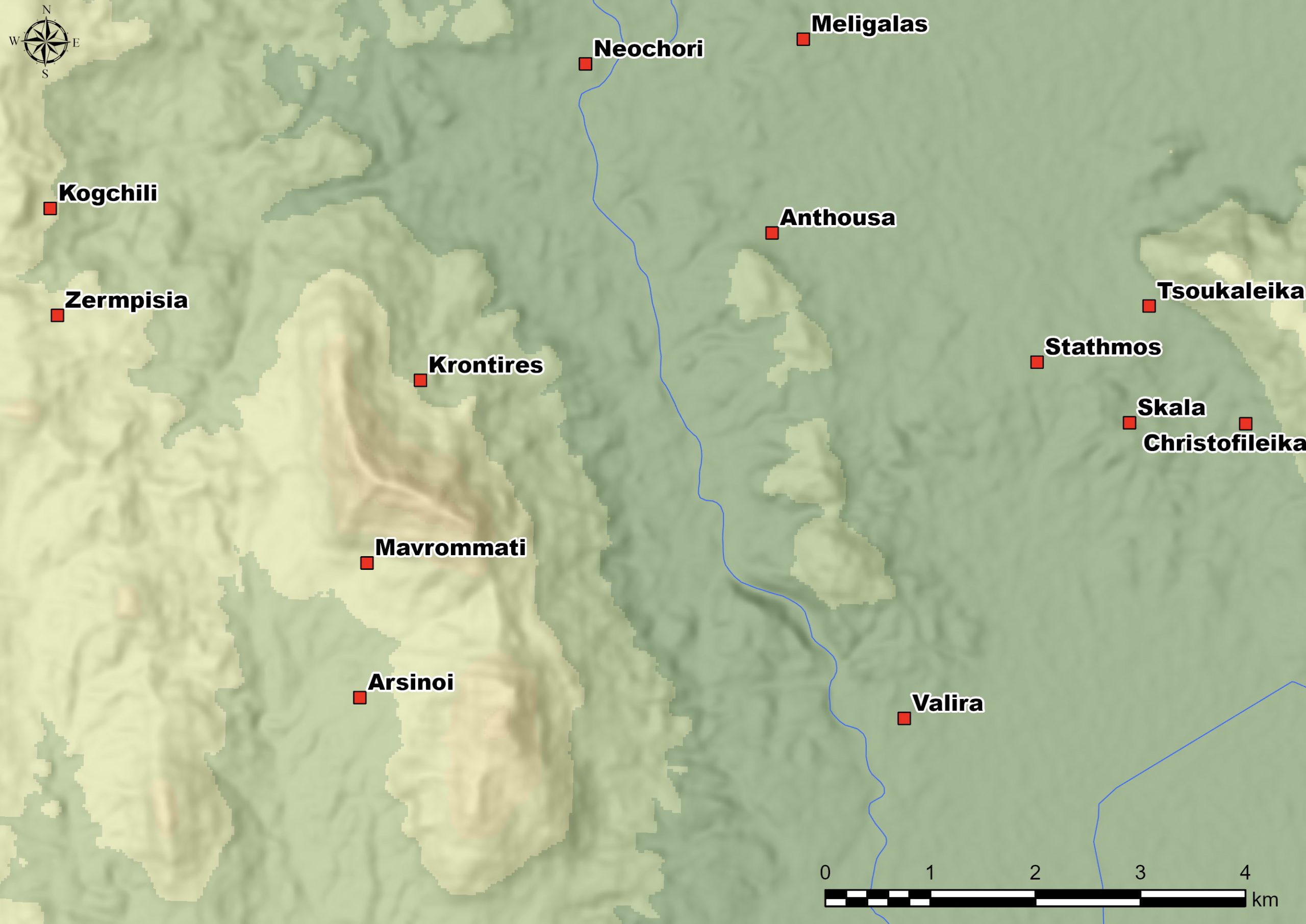
Messene Study Area
Figure 14: Messene Study Area. This is a foundational relief map of the Messene study area. It shows the topography, highlighting the mountainous terrain (light-colored) and the valleys (green), along with the locations of key modern settlements, including Mavrommati, Valira, Neochori, and Meligalas. This map establishes the general geographical and topographical context for the Messenian analysis. All material is under copyright of the BALAA Project (@BALAA, @IMS/FORTH, @Nikos Tsivikis).
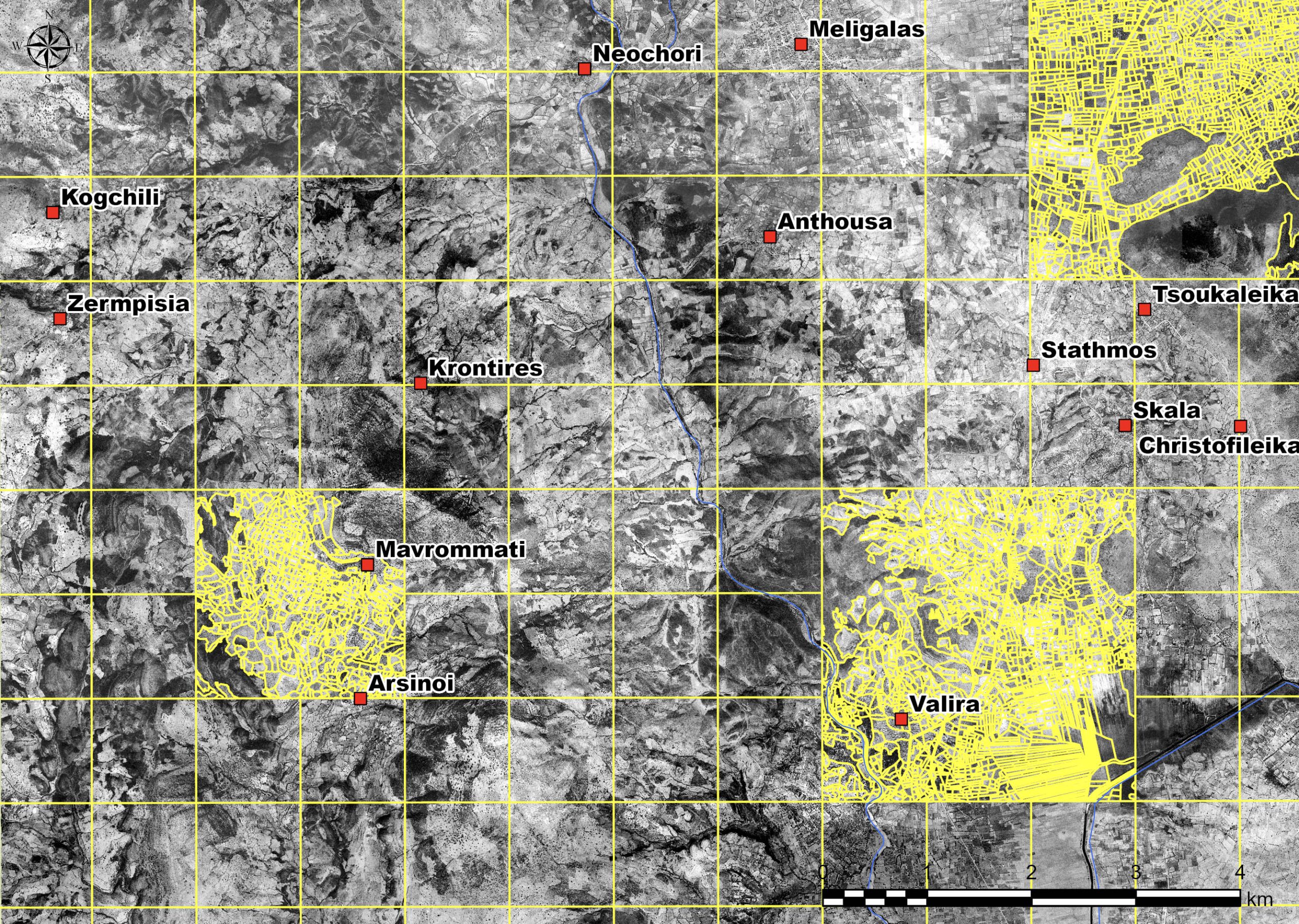
Messene Study Area - Orthophtography bases on 1945 maps
Figure 15: Messene Study Area - Orthophtography bases on 1945 maps. This map presents a historical layer of data, using orthophotography from 1945 as its base. This greyscale aerial imagery is overlaid with a grid and identifies the same key settlements. The yellow overlays in areas like Mavrommati and Valira appear to show historical land parcel data from that period, providing a crucial "snapshot" of the landscape before post-war agricultural modernization. All material is under copyright of the BALAA Project (@BALAA, @IMS/FORTH, @Nikos Tsivikis).
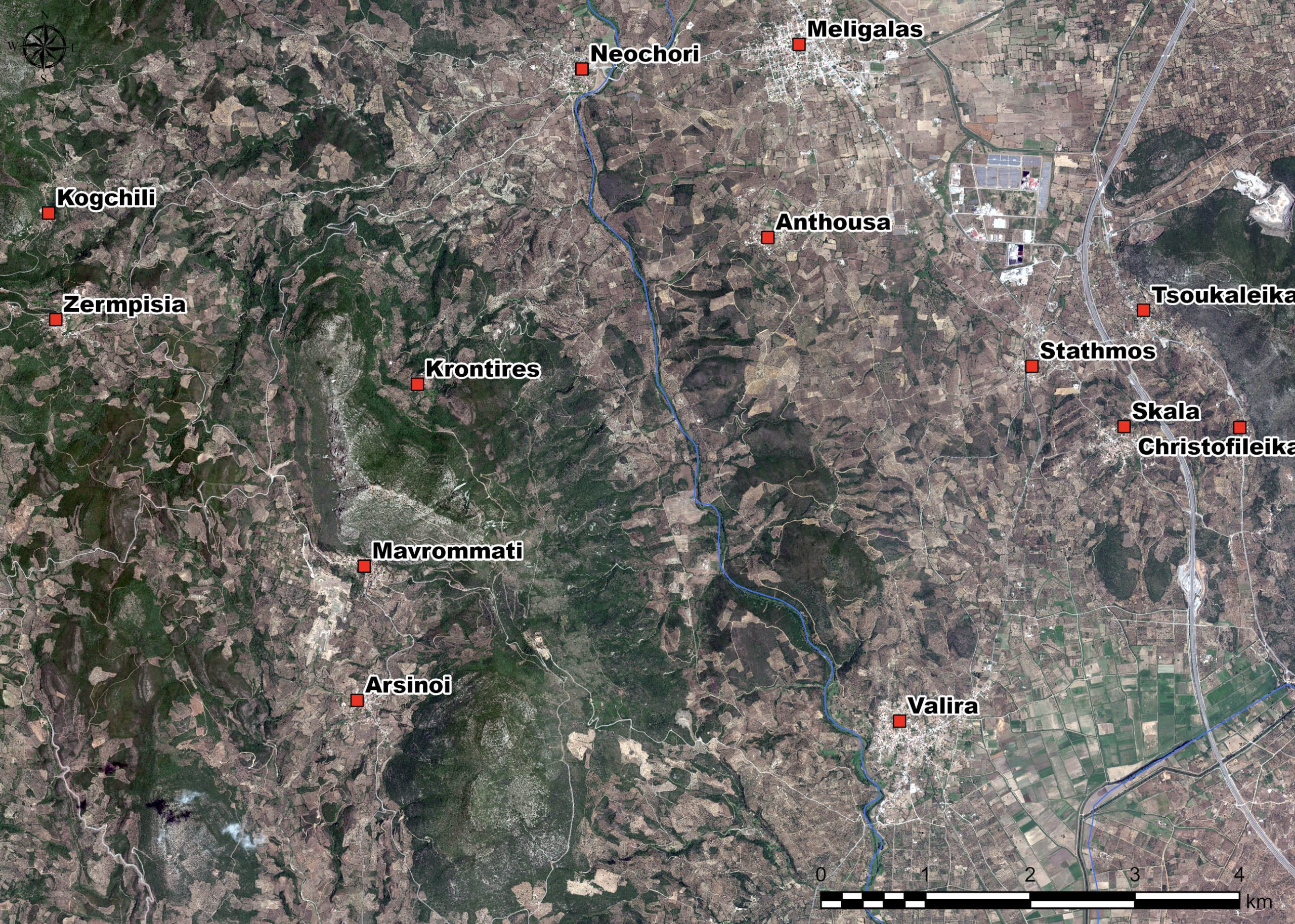
Messene Study Area - Satellite image with referenced sites
Figure 16: Messene Study Area - Satellite image with referenced sites. This map provides the modern-day equivalent to Figure 14. It is a high-resolution, natural-color satellite image of the entire Messene study area. It serves as a modern reference map, clearly showing the current landscape, land use, and the precise locations of the referenced settlements, allowing for direct comparison with the 1945 orthophotos. All material is under copyright of the BALAA Project (@BALAA, @IMS/FORTH, @Nikos Tsivikis).
Messene Study Area - Modern to Medieval Land Division near Tsoukaleika
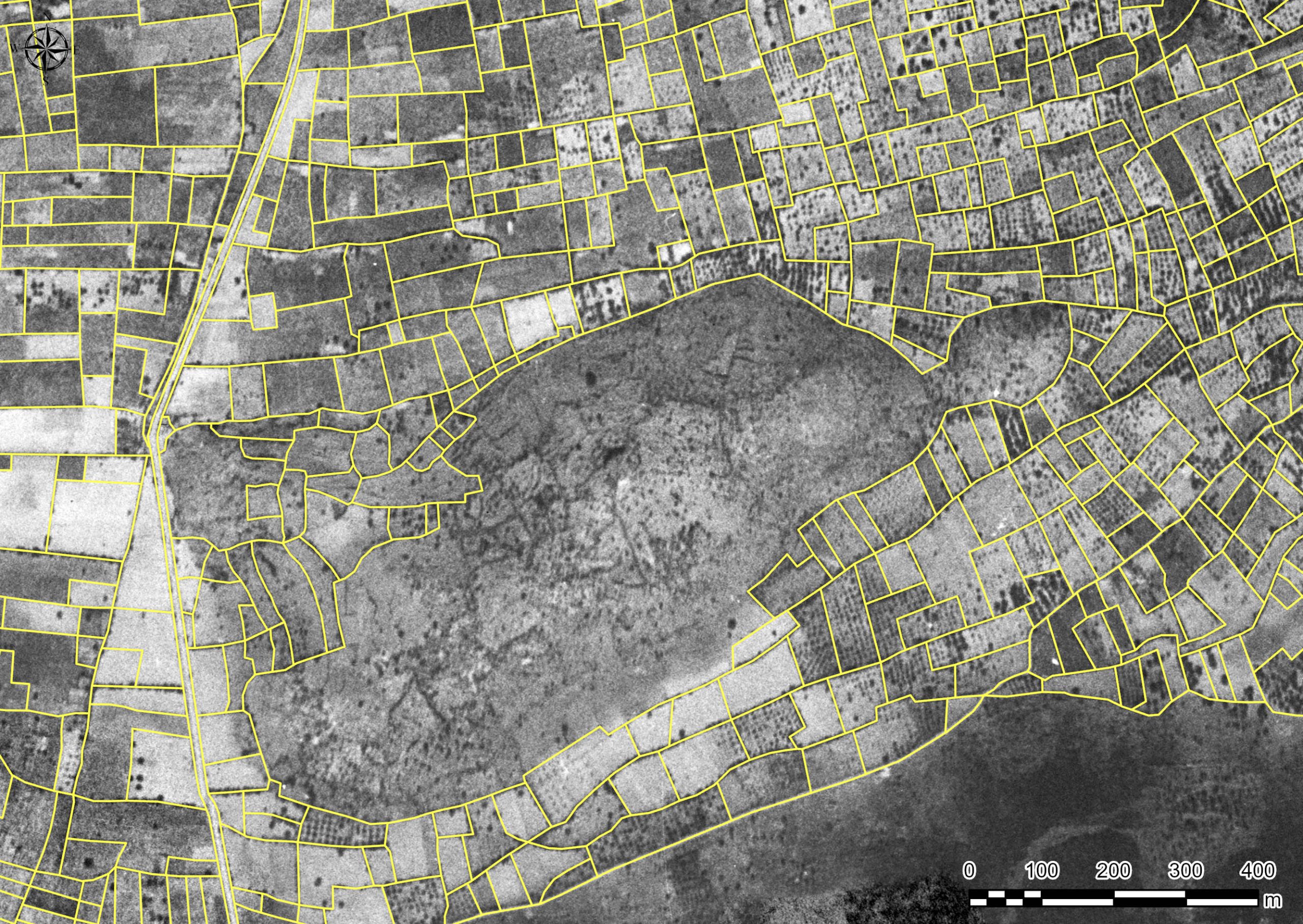
Figure 17: Messene Study Area - Modern to Medieval Land Division near Tsoukaleika. This image is a close-up of a pre-1945 orthophoto, focusing on an area near Tsoukaleika. It shows an uncultivated (wooded?) central area surrounded by agricultural parcels. The yellow lines represent the land divisions (parcels) as they existed at that time, providing a detailed micro-study of historical land tenure and use in this specific part of the Messene landscape. All material is under copyright of the BALAA Project (@BALAA, @IMS/FORTH, @Nikos Tsivikis).
Messene Study Area - Land divisions east of Valyra pre-1945
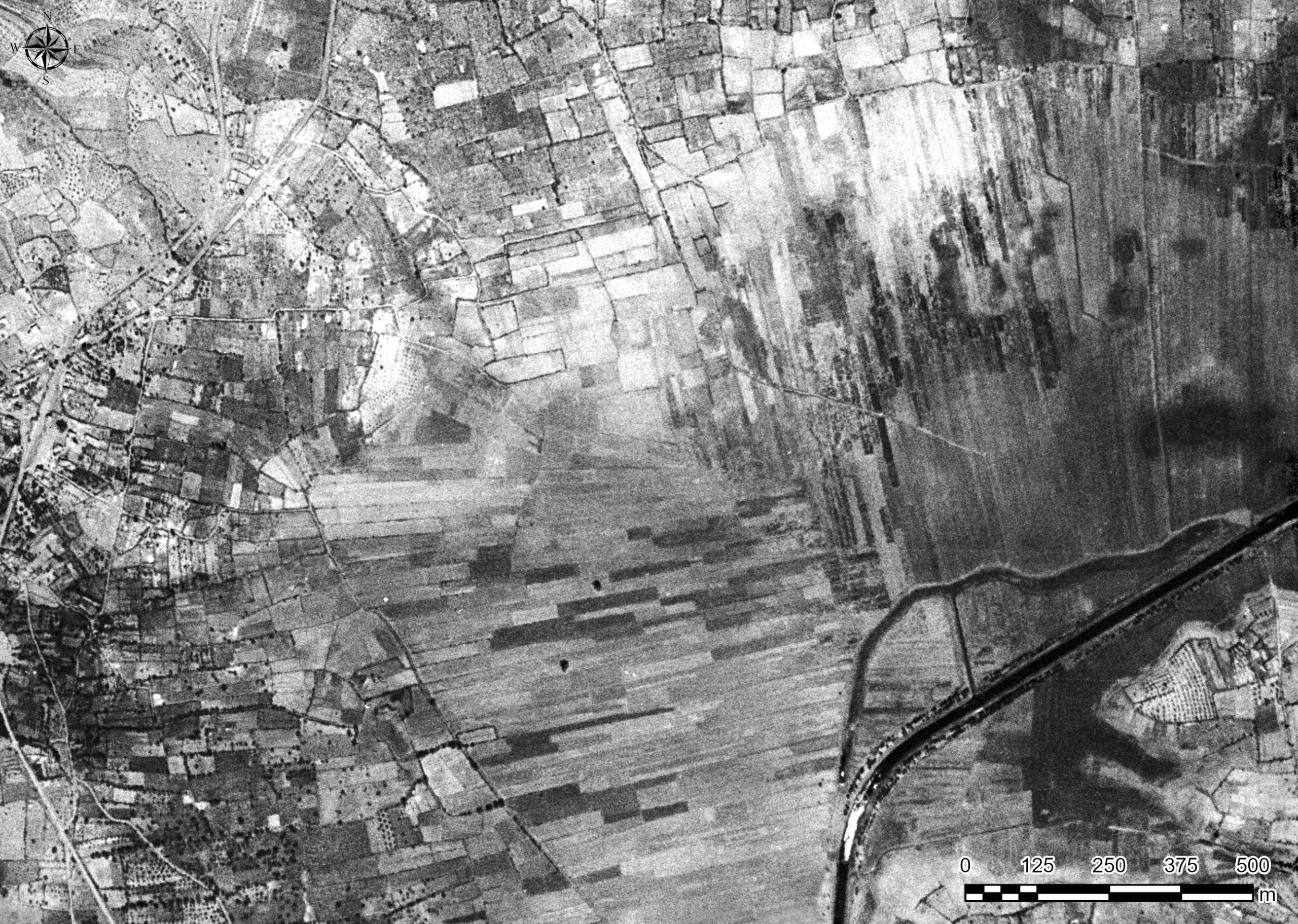
Figure 18: Messene Study Area - Land divisions east of Valyra pre-1945. This is a pre-1945 greyscale aerial photo focusing on the land divisions east of the settlement of Valyra. It reveals a complex agricultural landscape composed of numerous small, irregular, and strip-like field parcels. This image captures the historical state of the landscape, clearly showing field boundaries and a river or major road cutting through the area. All material is under copyright of the BALAA Project (@BALAA, @IMS/FORTH, @Nikos Tsivikis).
Messene Study Area - Land divisions eat of Valyra modern with landscape change
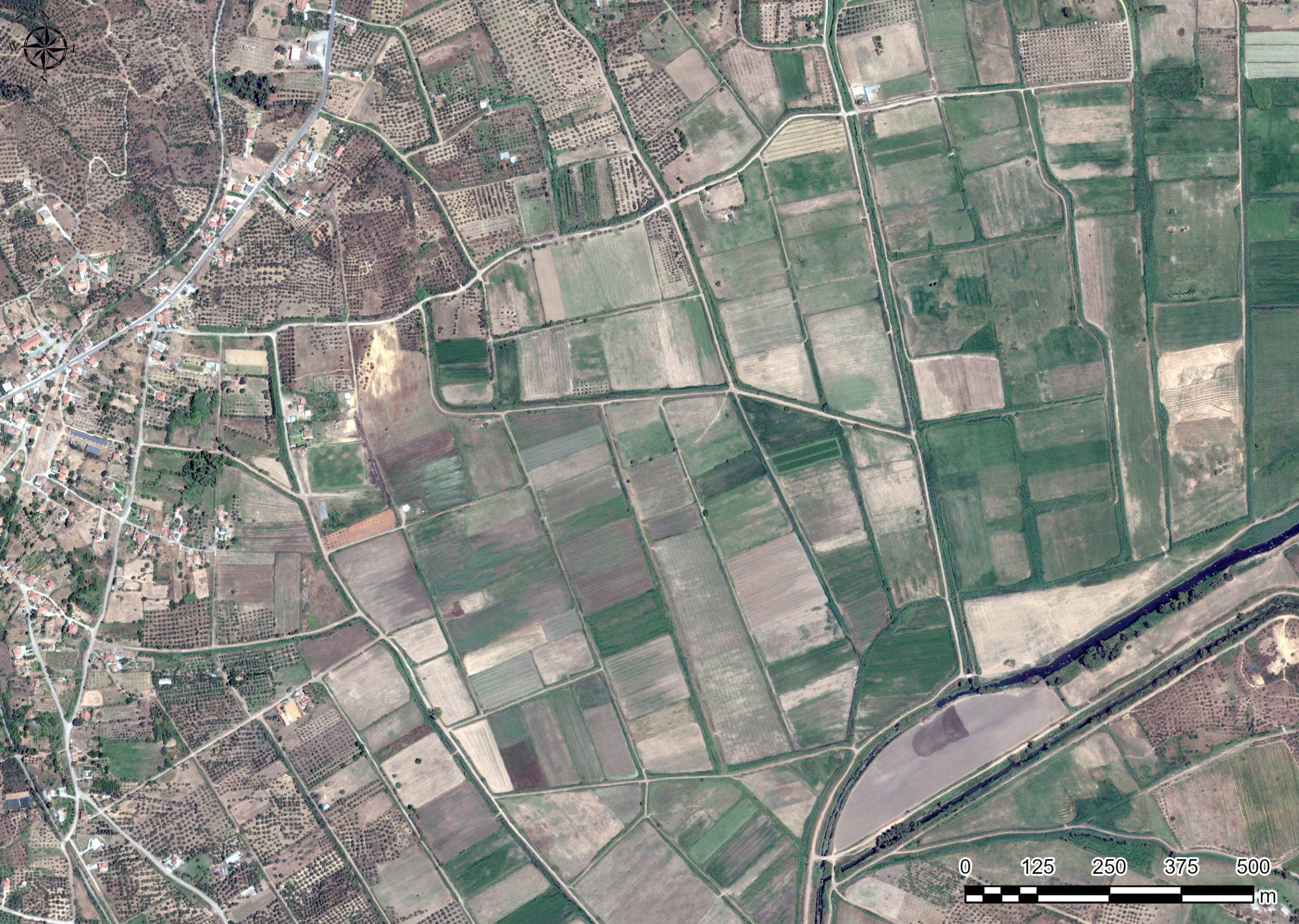
Figure 19: Messene Study Area - Land divisions eat [east] of Valyra modern with landscape change. This map is a powerful tool for diachronic analysis. It shows the exact same geographical area as Figure 18, but it uses modern, full-color satellite imagery. By directly comparing this image with the pre-1945 version, one can precisely identify "landscape change", noting which historical field boundaries have been preserved and which have been erased or consolidated by modern agricultural practices. All material is under copyright of the BALAA Project (@BALAA, @IMS/FORTH, @Nikos Tsivikis).
Messene Study Area - Terrace use by count graduated map
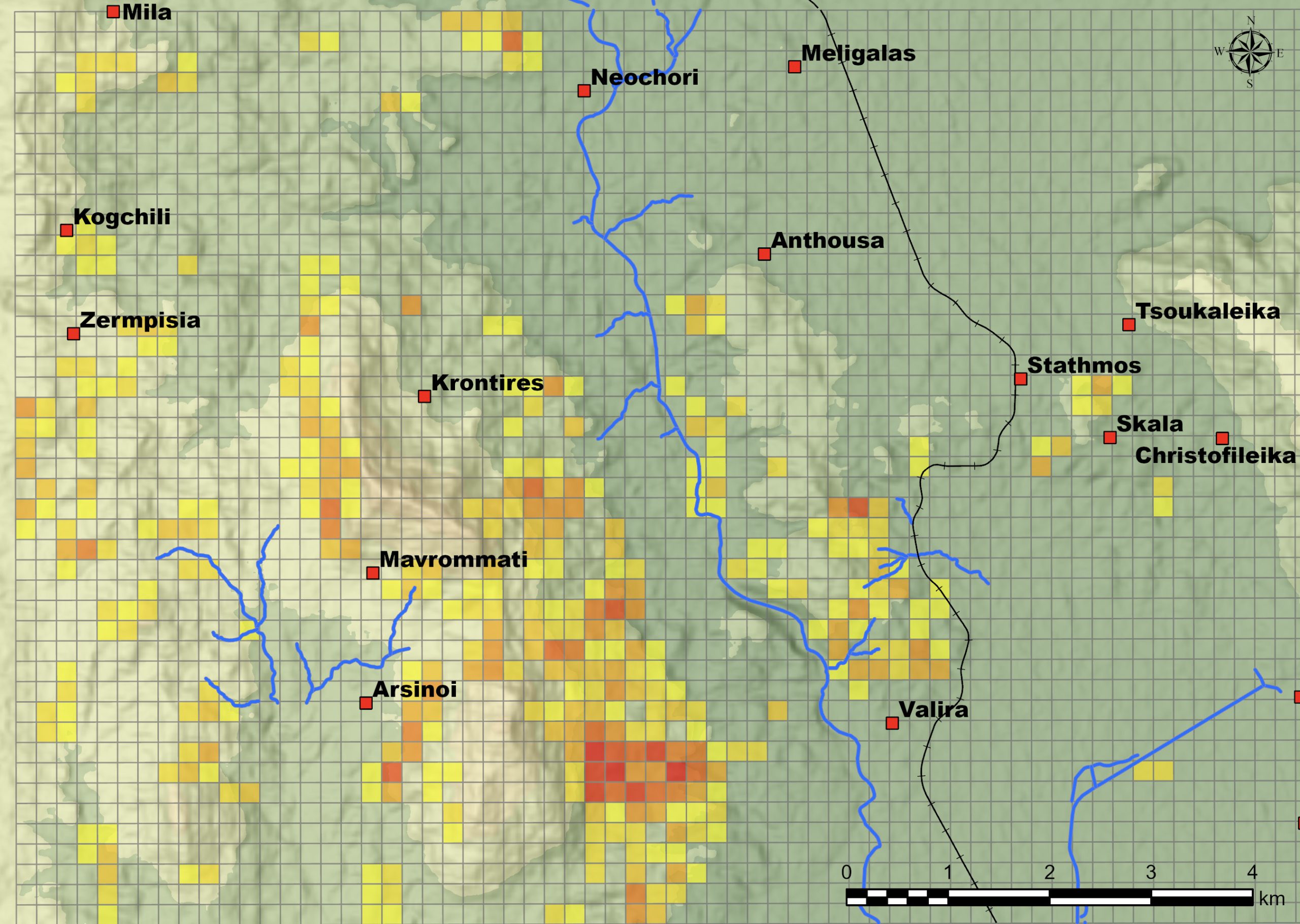
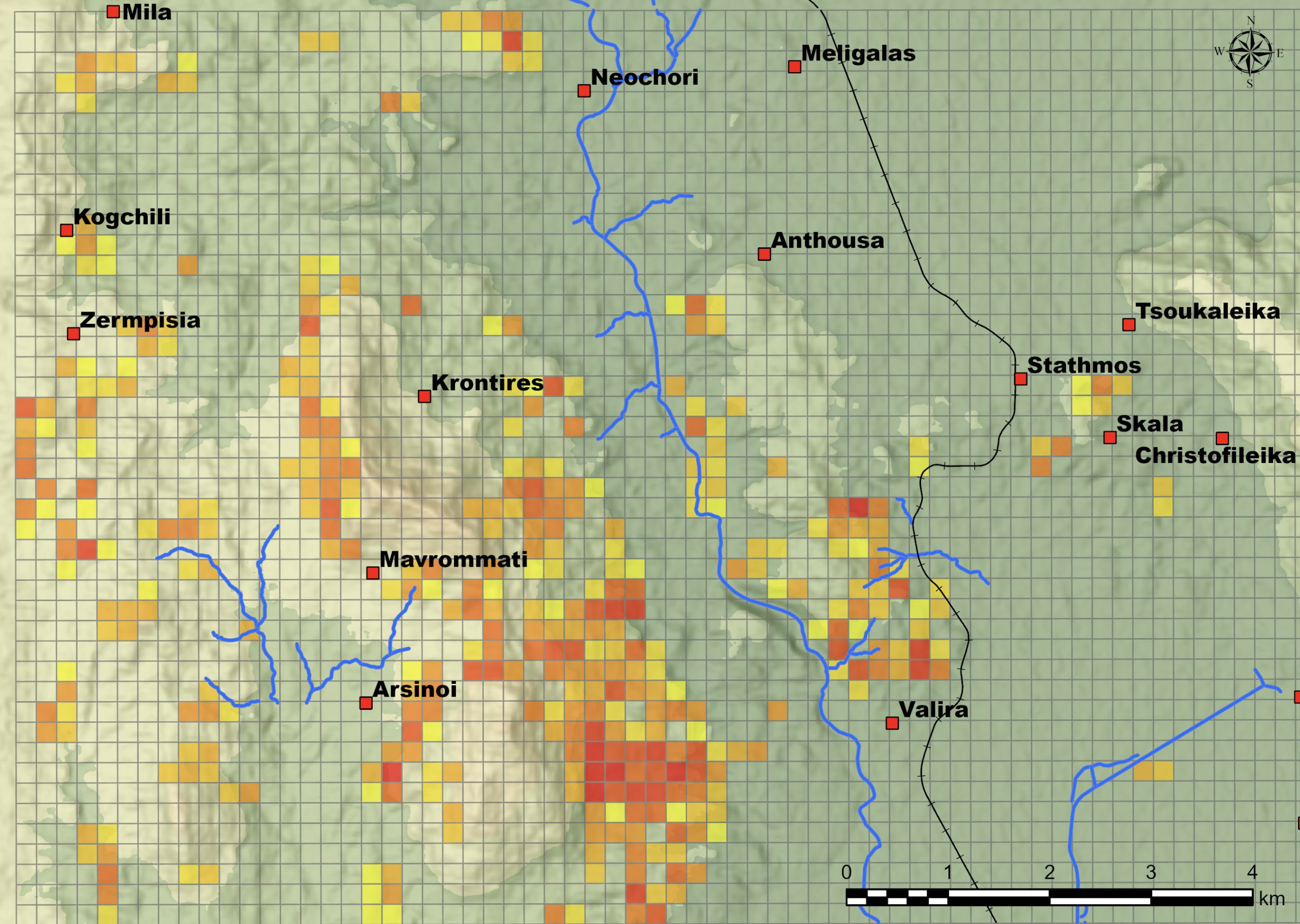
Figure 20: Messene Study Area - Terrace use by count graduated map. This is a GIS-generated "heat map" that visualizes the density of agricultural terraces across the Messene study area. The grid cells are color-coded from yellow (low count) to red (high count) based on the number of distinct terrace features identified within each cell. The map clearly shows high concentrations of terracing on the slopes around Mavrommati, Arsinoi, and Valira. All material is under copyright of the BALAA Project (@BALAA, @IMS/FORTH, @Nikos Tsivikis).
Messene Study Area - Terrace use by length graduated map
Figure 21: Messene Study Area - Terrace use by length graduated map. A companion analysis to Figure 20, this heat map visualizes terrace use based on total length rather than count. The similar distribution pattern, with red and orange cells concentrated in the same areas, confirms that these regions (e.g., south of Arsinoi) not only have many terraces but that these terraces are also extensive in length, representing a significant investment in landscape modification. All material is under copyright of the BALAA Project (@BALAA, @IMS/FORTH, @Nikos Tsivikis).
Messene Study Area - Actual terraces mapped on orthophtography
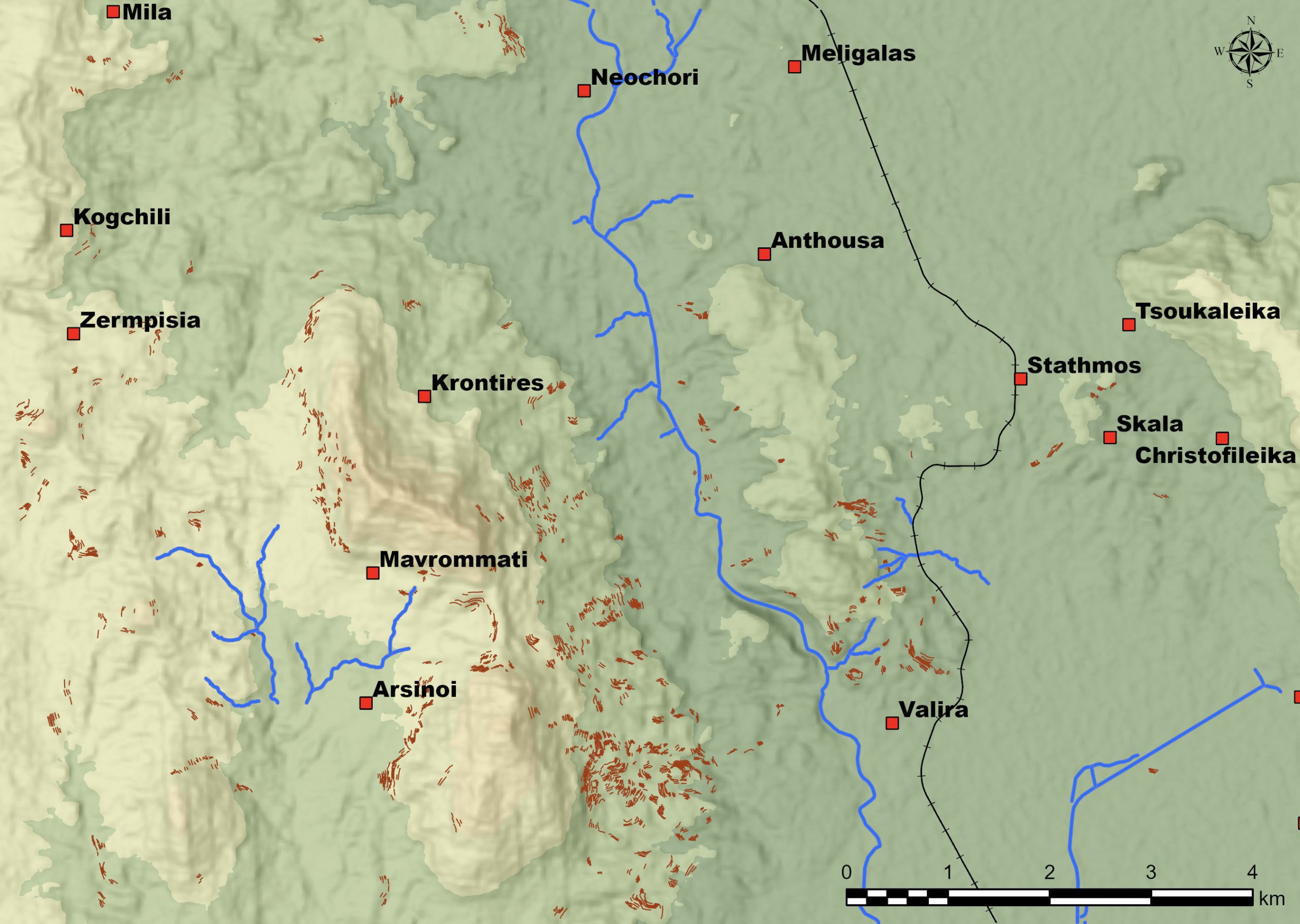
Figure 22: Messene Study Area - Actual terraces mapped on orthophtography. Moving from the generalized heat maps, this image plots the actual mapped locations of identified terraces (as small red features) onto the baseline relief map. This provides a more precise spatial understanding, demonstrating visually how the terraces are clustered almost exclusively on the sloped, highland areas (the lighter-colored terrain) and are absent from the flat valley floors (the green areas). All material is under copyright of the BALAA Project (@BALAA, @IMS/FORTH, @Nikos Tsivikis).
Messene Study Area - Actual historical Terraces on pre-1945 images SE of Messene
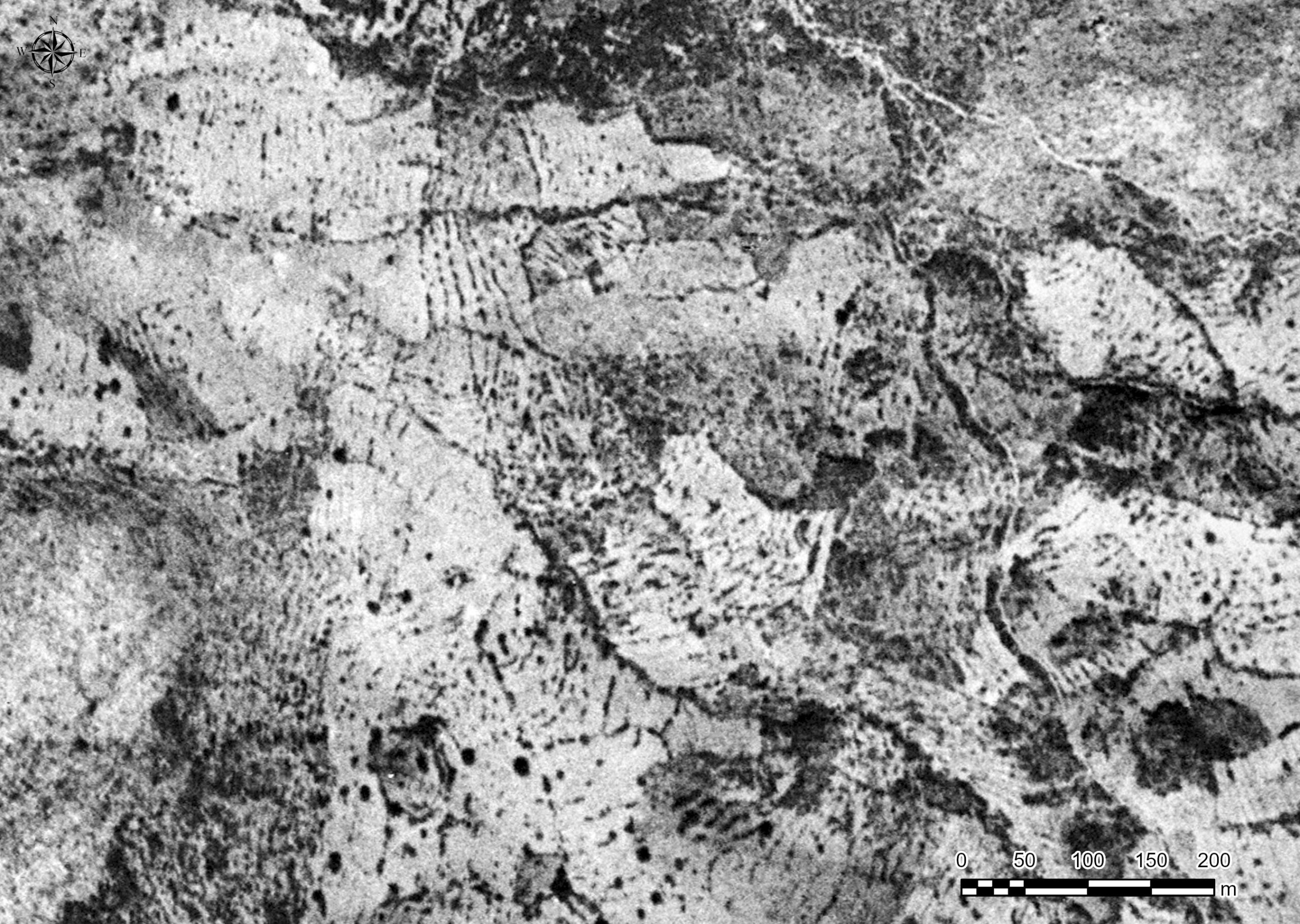
Figure 23: Messene Study Area - Actual historical Terraces on pre-1945 images SE of Messene. This final image provides a highly detailed, close-up view of historical terraces on a pre-1945 greyscale orthophoto, taken southeast of Messene. At a 200-meter scale, one can clearly see the intricate, winding, and dense network of stone terraces covering an entire hillside. This "on-the-ground" historical view powerfully illustrates the massive scale of human landscape modification central to the region's agricultural history. All material is under copyright of the BALAA Project (@BALAA, @IMS/FORTH, @Nikos Tsivikis).